
Wild turkeys are the ultimate comeback birds
While most of us enjoy at least one meal featuring delicious turkey this time of year, the big birds also are gaining attention from wildlife gardeners who enjoy watching them.
While I have yet to see a wild turkey (Meleagris) in my suburban Raleigh neighborhood, I always keep an eye peeled in more rustic areas to try to catch a glimpse of turkeys wandering along the roadside, or even slowly winding their way across the road in front of me.
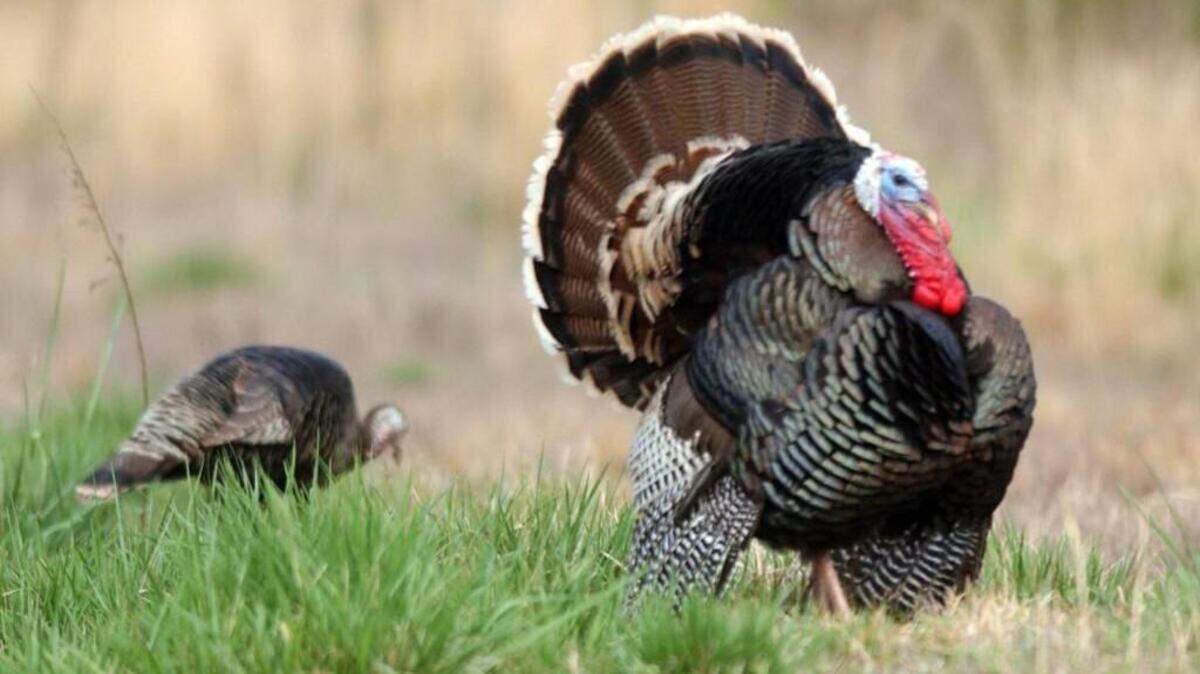
With a wide wingspan, dramatic coloring and odd vocalizing, turkeys definitely stand out in a crowd. Male turkeys make their gobbling sound while spreading their tail feathers in an attempt to attract females. He wears a red “snood” hanging on his forehead and a wattle on his throat. Males also may have multiple “beards” – which are actually an unusual type of feather.
Admittedly, turkeys haven’t been top of mind for me as a wildlife gardener. In fact, many gardeners consider turkeys a menace for their tendency to dine on any unprotected vegetable patch and dig for grass seed.
But when I did some investigation, I found out that wild turkeys are really special animals that have made a dramatic comeback since almost disappearing entirely as a species.
In the 16th and 17th centuries, or thereabouts, some 10 million turkeys occupied what is now the United States and Mexico. The big birds were revered by the ancient Aztecs as religious icons. Mayans used their feathers to adorn jewelry and clothing.
When Europeans arrived shortly afterward, they found a seemingly infinite turkey supply stretched across the horizon. It was a field day in terms of available and nutritious game for a growing population across the continent.
Fast forward a couple of hundred years, and the situation has drastically changed. By the late 1800s, wild turkeys were well on their way to extinction. Unregulated hunting combined with habitat loss to logging and farming reduced the wild turkey population to fewer than 200,000 all across the United States, according to the National World Turkey Federation (NWTF), a group of hunters and turkey enthusiasts who promote habitat preservation and conduct research.
While initial efforts focused on releasing domesticated turkeys to repopulate the countryside as wild birds, as it turned out, nurture was stronger than nature. Offspring of wild turkey hens were vastly more capable of living to adulthood than chicks born to females raised in captivity.
The solution appeared to lie in restoring the wild turkey’s habitat of forests, shrubs and native grasses, as well as relocating wild birds from areas of the country that still supported them, including the Southeast. During the Great Depression, 14 million abandoned farms instigated a natural restoration of the landscape, kick-starting the comeback.
Although wild turkey populations now are thriving, farm-raised turkeys still grace most of our dinner tables. More than 250 million turkeys were raised on farms in 2013, of which 46 million were consumed on Thanksgiving, 22 million at Christmas and another 19 million at Easter, according to the University of Illinois “Turkey Facts.” The remainder gets taken care of by the restaurant and grocery industries, because turkey remains a major food source in the United States.
Today, an estimated 7 million wild turkeys live in the United States. Along with serving as game for hunters, they have additional roles to play.
Wild turkeys play two roles in the ecosystem: both as a predator and prey, according to Florida State University’s helpful Habitat Tracker site: “Wild turkeys will feed on almost any insects, small rodents, and many plants. This helps keep these populations from overcrowding others in the area.”
As prey, turkeys are a source of protein for other birds and reptiles who eat turkey eggs, as well as small mammals that consume turkey hatchlings. Full-grown birds are valuable prey to larger mammals, including humans.
The N.C. Wildlife Resources Commission reports that around 18,000 wild turkeys are taken by hunters each year in the state, and two turkeys per hunter are allowed.
But the turkey might not be so much a turkey after all.
Only about 5 percent of hunters meet the two-turkey bag limit each year; 16 percent take one turkey; and 79 percent of turkey hunters go home empty handed.
This story was originally published December 3, 2017 at 2:37 PM with the headline "Wild turkeys are the ultimate comeback birds."